
The AI Credibility Crisis

We've all been there.
You're scrolling social media and notice that everything kind of looks the same. Everything has the same cadence. And for many, it is becoming frustrating that it all feels like a sea of sameness.
Now think about when you have a problem with an order, and you reach out, just to get hit with a chat bot. You're stuck in that all-too-familiar AI doom loop, begging to talk to a real person.
That is what we're going to be talking about today. We're going to cover three topics:
1) How consumers are worried about the impact of AI
2) How consumers are stuck and even addicted to AI
3) How the trust breaks down, and what that means for consumers
Before we jump into the data, I have a favor to ask.
If you enjoy this content, I would love it if you could share it with your friends and colleagues and subscribe on YouTube. It will really help us continue to provide great content and get the message out about joy.
The Worry Around AI
Now this data may feel kind of perfectly predictable, but it's important context to set the stage for the rest of the story.
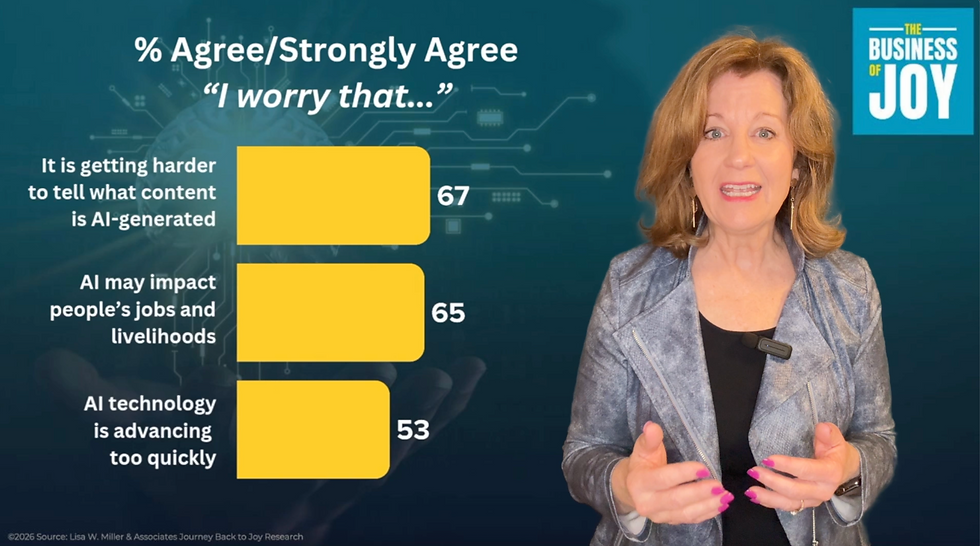
67% of Americans today are saying that they worry they can't tell the difference between real content and AI generated content. And as consumers use more AI, our natural writing is beginning to sound like AI. Not good.
Consumers are also worried about AI's impact on livelihoods and jobs. We see that all the time in the headlines. Half are also worried that in general AI is moving too quickly.
This foundation of worry is what is actually beginning to erode some of the trust.
The Conundrum: Consumers Are Stuck
Consumers don't love AI, but they have trouble not using it.
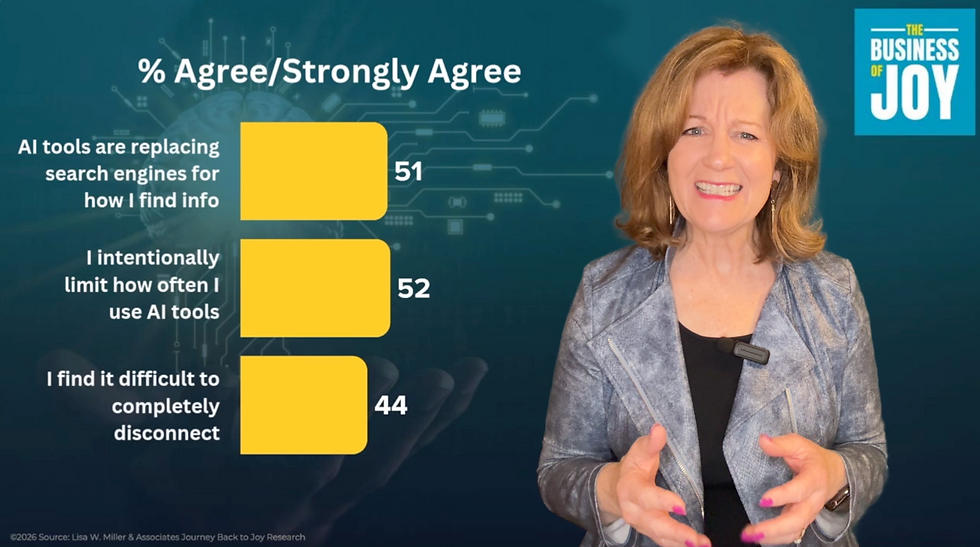
About half of consumers today say that they have replaced traditional search engines with AI when they need to find information.
I also found it interesting that about half say they're trying to limit their AI usage, because they feel worried about it.
But here's the catch, about four in ten say it's difficult to shut down their screens and to stop using social media and AI.
The paradox is that consumers are addicted to these technologies, but they're worried about the implication. This tension between the two is where opportunity may lie.
The Trust Gap
Even though consumers are using AI quite a lot, it doesn't mean they trust the content and the outputs they are getting. Only 26% of Americans actually trust content generated by AI. So that leaves the other 74% actually questioning or distrusting it altogether.
That lack of trust leads to continuous tension. While new models, updates, and features are cool, they're not making things better for consumers. All that misses the core issue of improving trust.
So What? Now What?
When companies deploy AI tools that are consumer facing, we have to acknowledge that there's skepticism, doubt, and mistrust. Businesses that don't hide AI usage, and instead actually take the time to put a human face around it, are the ones that will succeed.
We cannot miss the signal that AI use does not lead to AI trust. Use AI as the engine, but the trust has to start with the humans.
Until next time!
Lisa W. Miller is a consumer insights researcher, strategist, and founder of LWM Associates. A former VP of Innovation at Brinker International and VP of Insights & Strategy at Frito-Lay/PepsiCo, she has conducted proprietary research on Gen Z, American consumer behavior, and workplace dynamics. Her data has been featured in the Wall Street Journal and across more than 300 media appearances. Her podcast and newsletter, The Business of Joy, explores how leaders and consumers navigate an uncertain world.


I was looking for a detailed guide that explains the topic in a simple way, and this article provided a much better understanding than many other resources. The content was arranged properly, with each section covering useful information without unnecessary details. The explanation style made it easier to follow the important points, especially for readers who are exploring the subject for the first time. The discussion about FastWin Game was included naturally while explaining the overall features and important aspects related to the topic. I liked how the article focused on clarity instead of repeating the same information. Towards the end, FastWin Game was again connected with the main points, making the complete guide more informative and helpful.