
They're Not Quitters. They Just Never Got The Reps.
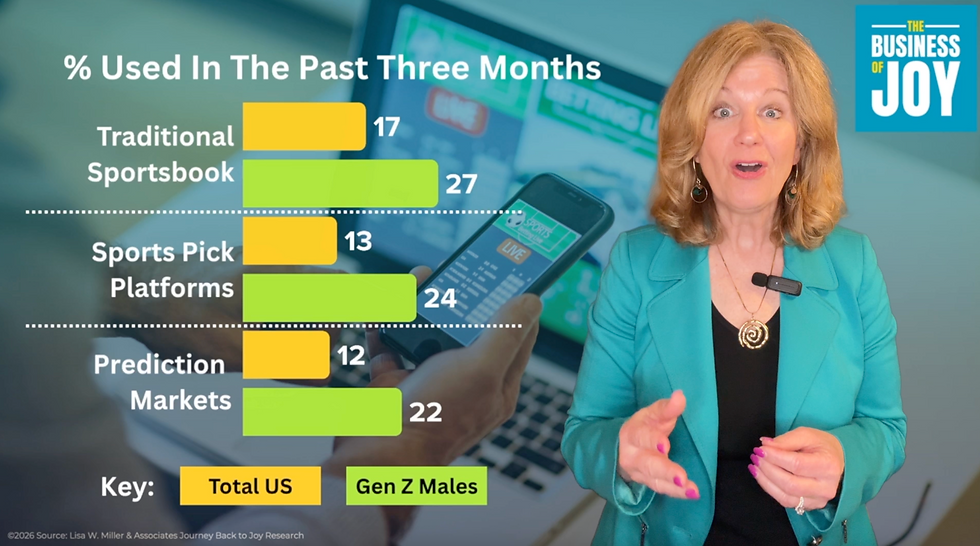
A recent Wall Street Journal op-ed pointed to the explosion of sports betting and prediction markets as evidence of America's declining work ethic, a generation looking for money without effort. The diagnosis is tempting. The data tells a different story.
I've spent the last two years conducting proprietary research on Gen Z, with thousands of interviews and surveys with young Americans ages 18 to 30. And separately, I've sat across from over 60 top executives on my podcast and asked each of them the same question: “What was your first job?”
The answers were humbling. Coat check girls. Dishwashers. Car warmers. Lawn mowers.
Greg Creed, former CEO of Yum! Brands, mowed lawns, and cleaned a factory floor. Julia Stewart, former CEO of IHOP and Applebee's, learned to read a table's emotional temperature at age 16, and she carried that skill to the boardroom. Sharon Price John, CEO of Build-A-Bear, sold pumpkins and worked a McDonald's drive-thru, yes, wearing one of those headsets. Arshay Cooper sat in freezing Chicago cars at 6 am to warm them up for others, scrubbed toilets between shifts, and wrote poetry in the quiet moments. He is now a celebrated author, activist, and motivational speaker.
None of them was doing glamorous work. All of them were earning their own money, yet it was so much more. They talked about learning accountability, resilience, the confidence that comes from doing something hard, and showing up the next day anyway.
My Gen Z research reveals exactly what happens when that foundation doesn't get built. Only 15% of Gen Z held a job before age 16. Among Boomers, that number is 47%. Millennials, 26%. Gen X, 39%. The data shows that these early reps are all but gone.
Gen Z didn't refuse them. We stopped offering them.
We raised this generation in a world optimized for safety and comfort. Structured activities replaced unstructured work and play. Participation trophies replaced performance feedback. And somewhere along the way, as my research shows, curiosity got trained out of them in school. They told us so themselves. 46% fall into what I call the Overwhelmed Middle, not in crisis, but not thriving either. Only 16% describe themselves as truly confident and capable.

So here is the question the work ethic argument never asks: what happens to a generation of believers who feel unprepared? Bettors still believe in the American Dream.
When I look at the people most actively using sports betting and prediction market platforms, across all ages and genders, 69% still believe the American Dream is achievable. That's 19 points higher than the general population. They are running toward something. They just can't find the on-ramp.

And a billion-dollar betting industry found them first.
Since a Supreme Court ruling in 2018 opened the door to legal sports betting, the industry has spent billions perfecting a product engineered for exactly this emotional state.
Financially squeezed, 61% of active users live paycheck to paycheck. Feeling left behind, 58% feel everyone else is moving ahead faster. But still hopeful. Still believing. The platforms aren't selling a wager. They’re marketing the aspiration of a better future.

The platforms are a symptom. The readiness gap is a major root cause.
Gen Z already knows what they need. They say it plainly in my research: real mentors, not cheerleaders. Honest feedback over empty praise. They acknowledge that the more difficult things they successfully do, the more confident they feel. They understand that confidence comes from doing. They've just had very little practice actually doing it.
Before we write off a generation as work-averse, we owe them a more honest accounting. They grew up watching Instagram wealth and overnight crypto millionaires. They came of age during a pandemic that locked them inside. They entered adulthood without the early reps that build the confidence to take the slow road. And then gambling companies showed up and offered them a shortcut.
And many took it.
Every CEO I interviewed found their way through early work because someone gave them a hard enough problem to solve on their own, and the space to solve it. That's the thread that runs from the freezing car in Chicago to the corner office.
Arshay Cooper, who warmed those cars at 14, put it better than any data point I have. "If you want something," he said, "you have to close the distance between your dreams and your actions."
Gen Z wants something. They want it badly. The question is who's going to help them close the distance, and whether we're asking them what they need, not just assuming we already know.
Lisa W. Miller is a consumer insights researcher, strategist, and founder of LWM Associates. A former VP of Innovation at Brinker International and VP of Insights & Strategy at Frito-Lay/PepsiCo, she has conducted proprietary research on Gen Z, American consumer behavior, and workplace dynamics. Her data has been featured in the Wall Street Journal and across more than 300 media appearances. Her podcast and newsletter, The Business of Joy, explores how leaders and consumers navigate an uncertain world.


Comments